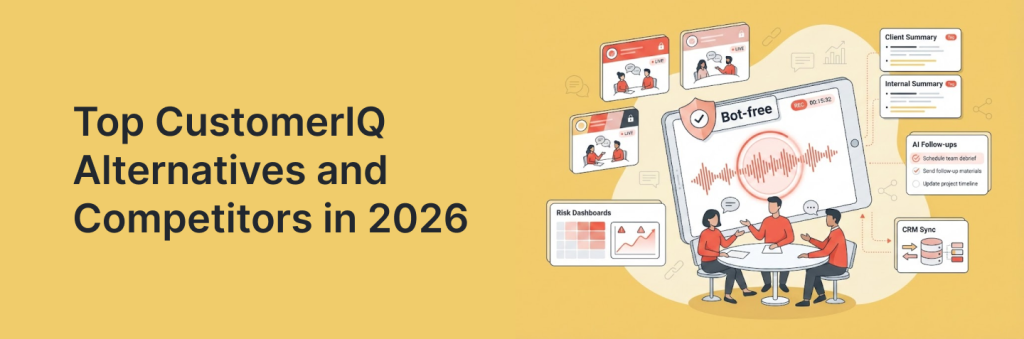
Looking for CustomerIQ alternatives in 2026? This list covers the top competitors teams are choosing for better call notes, stronger insights, and more automated follow-ups – so meetings don’t end as “great chat” and start turning into actions. Many of these tools now go beyond transcription with real-time coaching, deal signals, and workflow automations that reduce manual admin work. Let’s dive in!
TL;DR Best CustomerIQ Competitors (Features Overview)
1. FuseBase – Bot-free recorder with branded mini-rooms, client/internal summaries, AI follow-ups, CRM sync, and risk dashboards.
2. Avoma – Agenda-to-transcript sync, AI summaries with action items, collaboration/coaching, and Slack/CRM exports.
3. tl;dv – Real-time transcription and AI summaries with timestamped highlights, tagging, team libraries, and 30+ languages.
4. Meetgeek – AI summaries with action items, searchable library, 100+ coaching KPIs, templates, and broad integrations.
5. Fireflies – Fast AI summaries, powerful search, cross-platform transcription/video, and CRM/Zapier/API integrations.
6. Jamie – On-device, bot-free multilingual transcription/summaries with GDPR-first privacy and low-friction workflows.
7. Gong – Conversation and deal intelligence with risk flags, coaching, AI forecasting, and strong Salesforce integrations.
What is CustomerIQ?
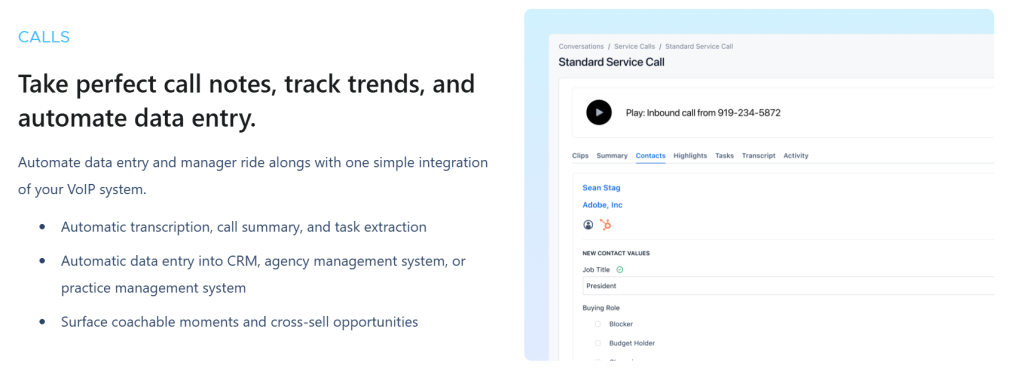
CustomerIQ moves past simple note-taking into full revenue automation, connecting meeting intelligence, email drafting, and CRM updates in one flow. It auto-joins calls, captures tasks and risks in the recap, creates follow-ups you can send or refine, and syncs everything back to HubSpot or Salesforce including contacts, companies, deals, stages, and custom properties. Use cases range from sales professionals maintaining high-touch communication, to busy executives delegating inbox triage, to customer success teams keeping CRM accurate while focusing on outcomes, to team leads distributing summaries minutes after calls. It’s typically used by sales and customer-facing teams to keep meeting knowledge searchable and reduce manual note-taking.
What to Look for in CustomerIQ Alternatives?
In 2026, the best CustomerIQ alternatives help your teams move faster from conversation to action. Use the checklist below to evaluate competitors based on what actually impacts pipeline execution, coaching, and customer outcomes.
- Summary quality you can trust – Look for consistently accurate summaries that capture the “why,” not just the “what”: decisions, objections, risks, commitments, and next steps.
- Action items that don’t get lost – Strong alternatives turn takeaways into real tasks with clear owners, priority, and due dates. Extra points if tasks can be pushed into your existing PM system or CRM so follow-through happens where your team already works.
- Follow-up automation that feels human – The best platforms draft follow-up emails and recap messages in your tone, pull key details from the call, and reduce copy/paste. Bonus if they support sequences, reminders, and next-meeting scheduling prompts.
- CRM-first execution and field mapping – If the goal is pipeline hygiene, confirm how deeply the tool supports CRM updates: mapping call outcomes to fields, updating the right objects, and handling edge cases (multiple contacts, multiple deals). Ideally, you can set review/approval rules so automation doesn’t create noisy or incorrect CRM data.
- Deal signals and coaching insights – Evaluate whether the tool surfaces deal risks, objection trends, stakeholder gaps, competitive mentions, talk ratios, and coaching patterns across reps – not just within a single call.
- Search, clips, and a usable call library – Your team should be able to find information fast by account, topic, speaker, or timeframe.
- Recording approach and compliance options – Many organizations require bot-free capture, explicit consent flows, and flexible retention policies. Make sure the tool supports the recording style your customers will accept and your security team will approve.
- Collaboration and standardization for teams – The best alternatives support shared templates, commenting, tagging, and playbooks so every rep’s call notes look consistent. This is what makes reporting, coaching, and handoffs actually scalable.
7 Best CustomerIQ Alternatives and Competitors
If CustomerIQ isn’t fully matching your workflow – whether it’s summary quality, automation depth, integrations, or how your team collaborates – there are plenty of strong options worth considering. Below are 7 best CustomerIQ alternatives and competitors, chosen for how well they turn calls into clear notes, actionable insights, and follow-ups that actually move deals forward.
1. FuseBase
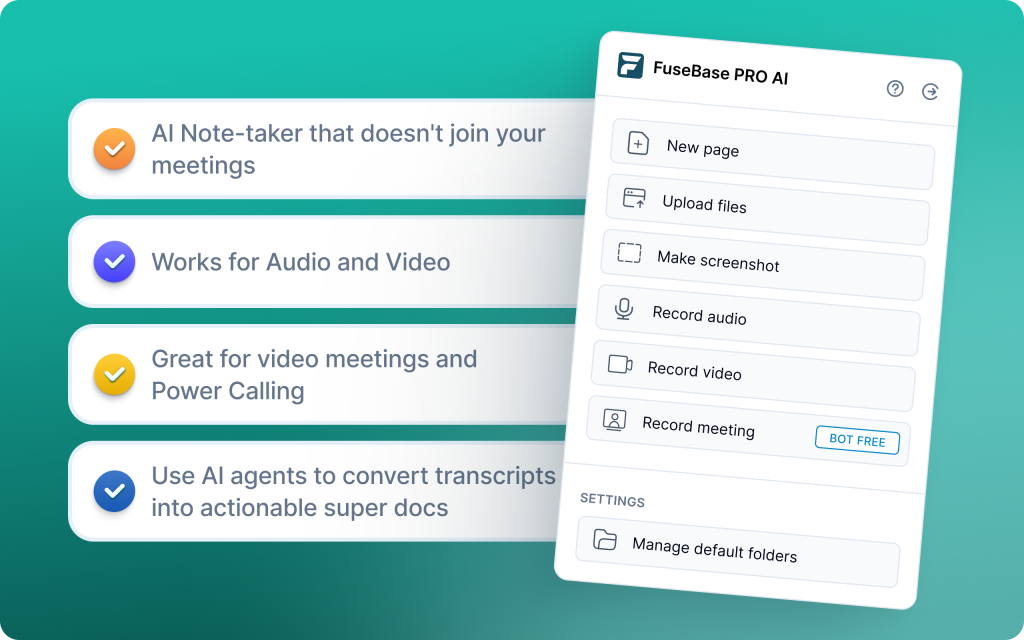
FuseBase is a bot-free AI meeting recorder and workspace that turns every Zoom, Teams, or Meet call into a branded mini-room with recap, decisions, next steps, and supporting assets. Each meeting auto-creates a lightweight client or deal room under your domain, so you share client-ready outputs while keeping internal risks and tasks organized in the same space. AI agents watch calls for revenue signals like no next meeting, budget gaps, scope creep, and renewal risk, then convert them into real tasks, trackers, and follow-ups across your tools. Dashboards roll up insights such as “calls with no next step” and “accounts with rising risk,” helping managers coach and intervene before deals stall. It’s a strong alternative if you need faster follow-ups, higher CRM completeness, and a premium, white-label experience for clients.
Pros:
- Bot-free recorder with branded, white-label mini-rooms per meeting
- Internal vs client-ready outputs for clean sharing without exposing internal notes
- AI agents that auto-create tasks, populate trackers, and trigger follow-ups in your stack
- Dashboards that highlight missing actions and rising-risk accounts
- All call assets in one place: notes, files, links, Loom-style videos, and recaps
Cons:
- Heavier than a pure notetaker
- Best value when you adopt the workspace approach
2. Avoma
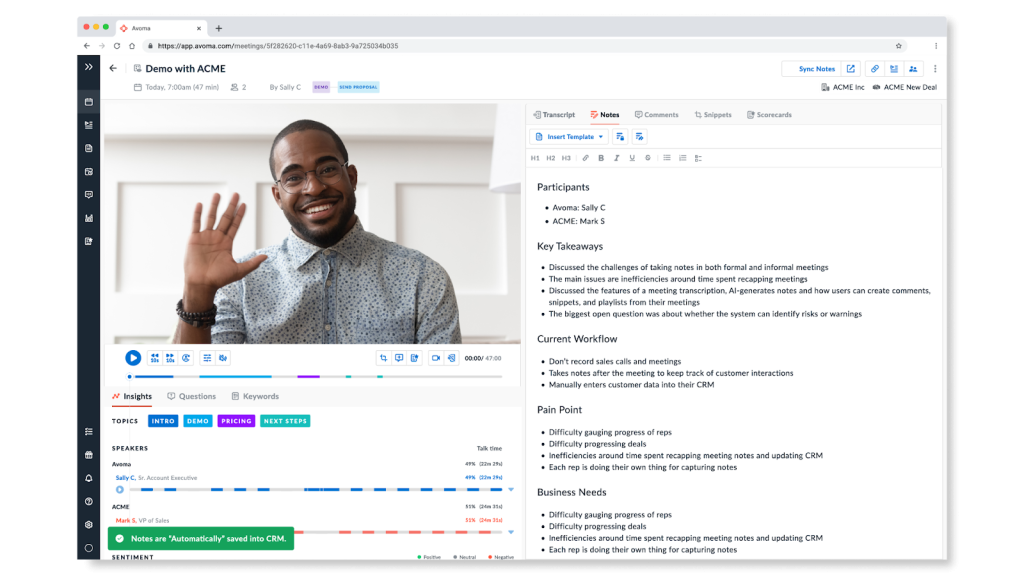
Avoma is an AI meeting assistant for cross-functional teams that need clean summaries, action items, and centralized visibility across sales, success, and product. It records on Zoom, Google Meet, and Microsoft Teams, syncs agendas with transcripts, and generates post-call notes you can push to Slack, CRMs, or internal docs. Conversation intelligence covers talk time, objection handling, and sentiment, while managers can review calls and coach with highlights. Avoma shines when you want end-to-end meeting workflows, collaboration, and easy adoption.
Pros:
- Agenda-to-transcript synchronization for a unified view of planned vs discussed
- AI summaries with automatic action item capture and exports to Slack/CRM
- Cross-functional collaboration via comments, highlights, and shared libraries
- Full meeting lifecycle support (pre-call agendas, live notes, post-call recaps)
Cons:
- Advanced analytics and insights live on higher pricing tiers
- Lighter forecasting and structured coaching depth than specialized CI tools
3. tl;dv
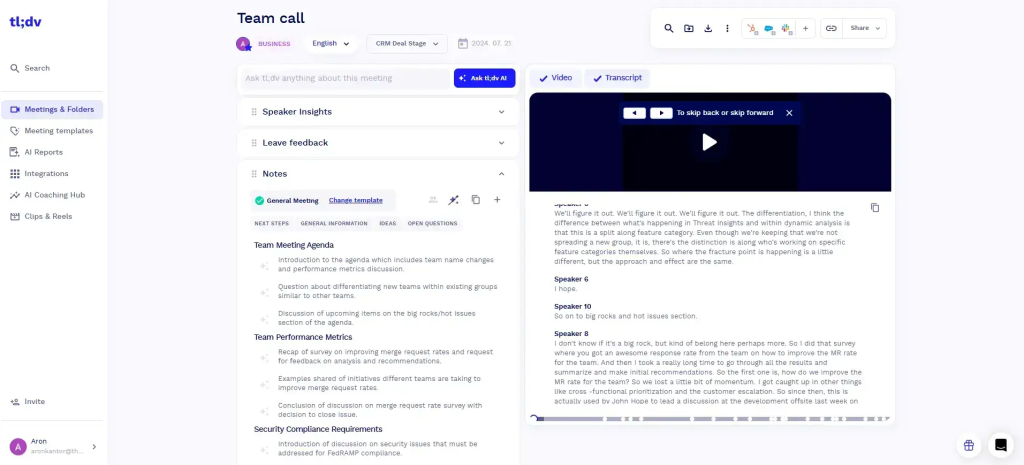
tl;dv is an AI-powered meeting recorder for Google Meet, Microsoft Teams, and Zoom that delivers real-time, highly accurate transcription and clean post-call summaries. It is popular with workshop facilitators and research-heavy teams for capturing group discussions, tagging key moments, and analyzing themes to improve future sessions. With timestamped highlights, 30+ language support, and a bot that can join Google Meet to generate summaries, it helps teams align on outcomes and next steps quickly.
Pros:
- Real-time transcription across Zoom, Meet, and Teams with 30+ language support
- Timestamped highlights, tagging, and team libraries for quick retrieval and research workflows
- AI-generated summaries that clarify outcomes and next steps post-call
- Cross-platform capture well suited for workshops and group discussions
Cons:
- Less focused on CRM workflows
- CI depth is surface-level with limited coaching capabilities
4. Meetgeek
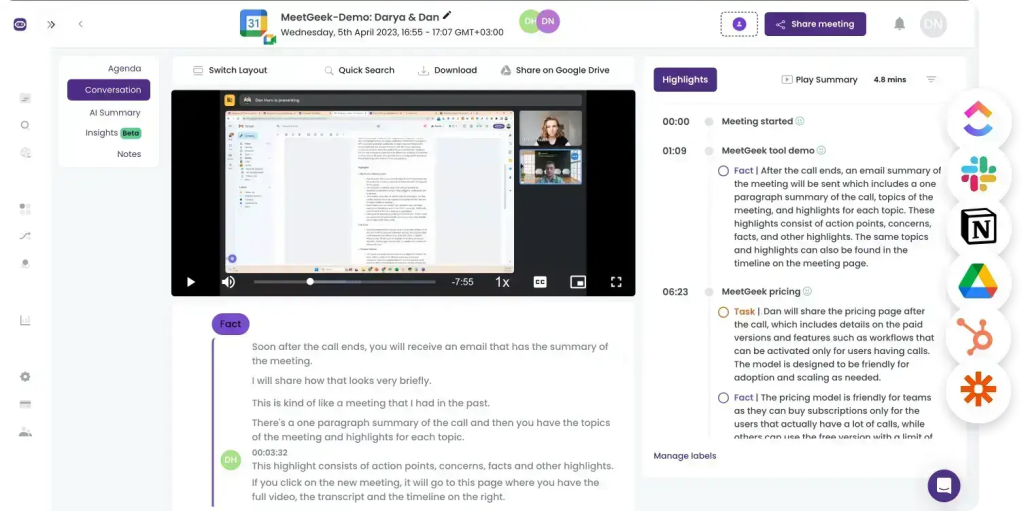
Meetgeek is a well-organized AI meeting assistant for revenue teams that need fast, consistent call summaries, clear action items, and easy handoffs. It records online or offline meetings, generates AI summaries with key points, and syncs notes into CRMs and collaboration tools via thousands of integrations. A searchable library, folders, and highlights make it simple to resurface decisions, while conversation intelligence surfaces engagement trends and speaker distribution for coaching. Meetgeek shines when you want organized recaps, coaching-ready insights, and broad integration coverage without heavy setup.
Pros:
- AI summaries with action items and key points after each call
- Broad integrations (Slack, HubSpot, Google Drive/Calendar, Zapier) for quick handoffs
- Searchable team library with highlights for fast retrieval and coaching
- Conversation intelligence with engagement metrics and 100+ KPIs, plus customizable templates
Cons:
- New meetings can take up to an hour to appear; mid-call start not supported unless pre-scheduled
- Free tier is limited, with advanced features on higher-priced plans
5. Fireflies.ai
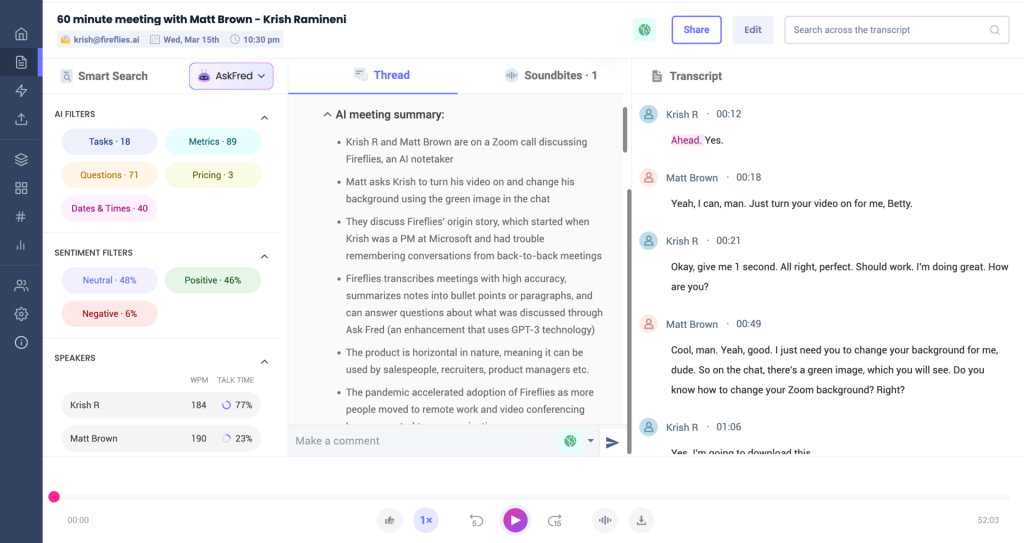
Fireflies.ai is a popular AI note taker and meeting recorder that excels at fast recap and retrieval. Powerful AI search lets you review a one-hour call in minutes, and a central library creates a searchable knowledge hub across recordings. With cross-platform transcription, video recording, and CRM integrations, it supports recap and light follow-up workflows for sales and CS. For reliable recording, summaries, and rapid search, Fireflies is a credible, cost-effective pick.
Pros:
- Top-tier AI summaries and rapid AI-driven search to review calls in minutes
- Cross-platform transcription and native video recording for Zoom, Meet, and Teams
- CRM and app integrations via native connectors, Zapier, and API for light automation
- Knowledge hub with collaborative comments, topic tracking, and AskFred assistant
Cons:
- Sentiment analysis may raise EU AI Act compliance concerns for European teams
- Language must be preselected and does not auto-detect mid-call switches
6. Jamie
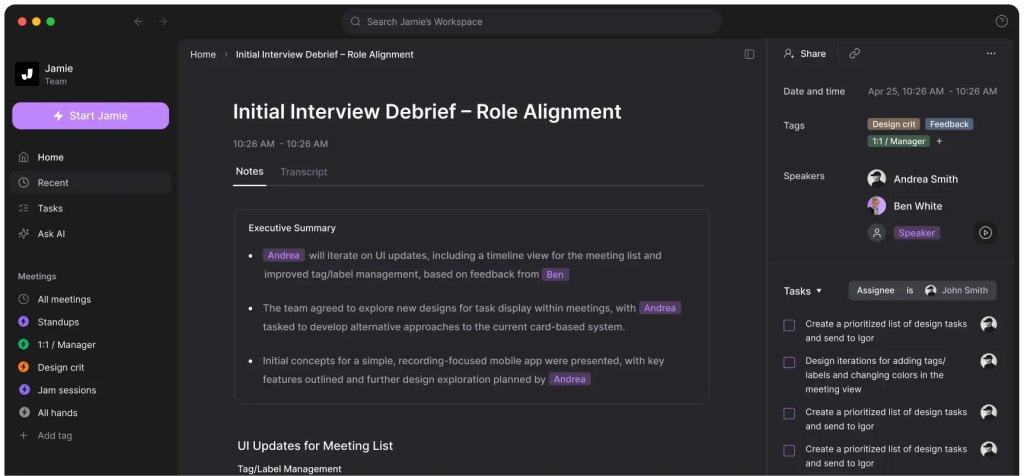
Jamie is a privacy-first, bot-free meeting assistant that runs on your device to capture and summarize conversations across both online and in-person meetings. It focuses on fast, multilingual transcription and customizable summaries that deliver clear next steps without introducing a bot to your calls. With a strong GDPR posture and EU hosting, Jamie minimizes friction and builds trust for compliance-conscious teams. It’s a compelling option if you prioritize speed, simplicity, and privacy over deep workflow automation.
Pros:
- Bot-free, on-device capture for online and offline meetings
- Multilingual transcription and summaries with customizable formats
- GDPR-focused and EU-hosted for strict privacy requirements
- Low-friction workflow that produces clear action items quickly
Cons:
- Fewer native CRM/ticketing integrations and lighter analytics depth
- Advanced plans can be costly for smaller teams
7. Gong
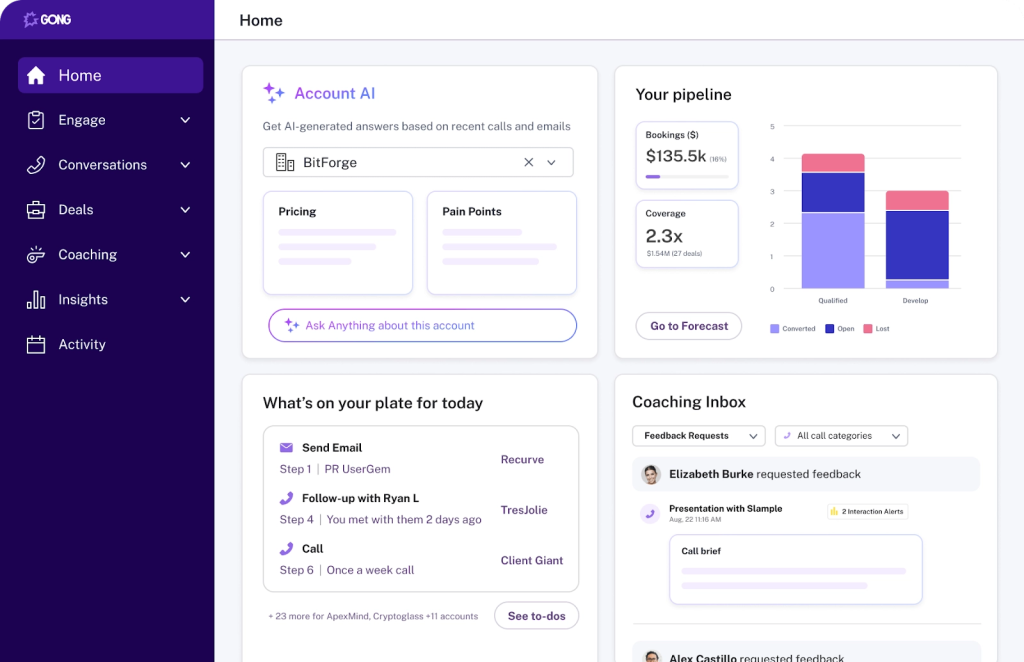
Gong is a revenue intelligence platform that transforms customer interactions into deal insights, coaching signals, and forecast inputs. It goes beyond transcription to analyze sentiment, topics, and product interest while flagging risks and next steps on active opportunities. Leaders get pipeline visibility and AI-driven forecasting, and reps receive post-call summaries with guidance that syncs to Salesforce and conferencing tools. If your priority is analytics-driven execution and predictable revenue, Gong is a strong CustomerIQ alternative.
Pros:
- Deep conversation and deal intelligence with risk flags and next-step guidance
- Pipeline visibility and AI forecasting that drive predictable revenue
- Coaching workflows with call libraries and scorecards for rep improvement
- Strong integrations with Salesforce, Zoom, and Google Meet plus AI summaries and follow-ups
Cons:
- Large data volumes can be overwhelming, and finding specifics in older calls can take effort
- Occasional transcription delays or inaccuracies may slow time to follow-up
Summary
The best CustomerIQ alternatives are the ones that don’t just summarize calls – they turn conversations into repeatable execution. That means consistently accurate notes, clear next steps, and follow-ups that actually land in the right place (CRM, tasks, pipelines, client threads), so the team doesn’t lose momentum after every meeting.
While there are strong competitors across conversation intelligence and lightweight notetaking, FuseBase stands out as the strongest option for teams that need outcomes, not just notes. Instead of living as another meeting archive, FuseBase pairs meeting intelligence with a structured workspace approach: meeting notes can become client-ready deliverables, internal follow-ups, and assigned tasks in one organized system. AI agents and automations help push next steps into your existing tools, while keeping everything trackable at the account level – so sales, CS, and operations can collaborate on execution without chasing context across docs, Slack threads, and CRM fields. The result is fewer dropped follow-ups, cleaner handoffs, and a repeatable post-call process that scales with the team.