Choosing an Avoma alternative is all about matching the product to how your team actually uses meetings. Some teams need revenue-grade coaching and deal visibility. Others care more about client-ready recaps, shareable highlights, or a workflow that turns call outcomes into tasks and deliverables without manual cleanup. This comparison breaks down seven top Avoma alternatives through a practical lens: what each tool is best at and which use cases it fits best across Sales and Customer Success.
Overview of Best Avoma Competitors
- FuseBase – Bot-free meeting recorder that turns every call into a branded mini-room with client-ready recap, internal-only risks, tasks, and automated follow ups.
- Supernormal – Structured documentation engine with customizable templates, real-time summaries, and automatic action item routing into tools like Salesforce, HubSpot, Asana, and Slack.
- Gong – Enterprise-grade conversation and revenue intelligence that ties call patterns to deal risk, coaching, and forecast accuracy.
- Fathom – Free-first, fast summaries and clips with CRM sync and follow-up drafts right after the call.
- tl;dv – Async-friendly recorder with multilingual transcription, highlight tagging, and clip sharing.
- MeetGeek – Accuracy-focused capture plus advanced analytics, sentiment, and 100+ KPIs, with 7,000+ integrations.
- CustomerIQ – Unifies calls and email into CRM-ready data, drafts contextual follow ups, and provides cross-channel insights with proactive alerts and coaching signals.
What is Avoma?
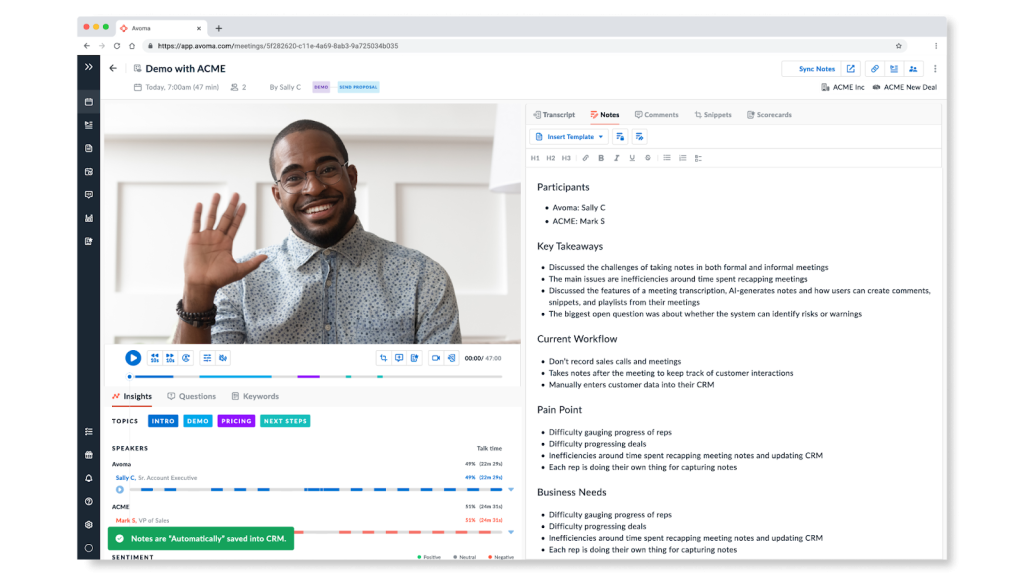
Avoma is an AI meeting assistant built for customer-facing teams – especially Sales and Customer Success – that helps capture, organize, and operationalize what happens in calls. At its core, Avoma records meetings, generates transcripts, and produces structured summaries, action items, and key takeaways so teams can move faster after each conversation. It also creates a searchable meeting library, making it easier to revisit decisions, confirm next steps, and onboard new teammates without digging through scattered notes. Beyond transcription, Avoma is positioned as a workflow layer for recurring meetings. Teams can use agendas and templates to standardize how calls run, while managers get additional visibility into conversations for coaching and process improvement.
In practice, Avoma is most useful when you want consistent call documentation, shared context across stakeholders, and a system that turns meeting content into repeatable, team-wide habits.
Challenges with Avoma
Avoma can be a strong meeting assistant, but teams often run into friction when they try to scale it across high-volume Sales and Customer Success workflows.
Inconsistent recap quality across meetings
Avoma can generate helpful summaries, but teams often notice variability from call to call, especially when conversations are messy, multi-threaded, or include multiple stakeholders. Some recaps come out crisp and actionable, while others feel generic, too long, or miss the commercial signal (decision criteria, risks, timeline, stakeholders). Over time, this inconsistency turns the tool into a “starting point” rather than a reliable output you can send to a client or drop into a deal record as-is.
Action items don’t always translate into execution
Capturing tasks is only the first step; the real value is when action items become assigned, tracked, and connected to the right workflow. Teams often find that action items still require manual work to be useful – adding owners, deadlines, context, and then pushing them into the system where work is managed. The result is predictable: missed next steps, slower cycles, and more internal chasing.
CRM updates can require manual cleanup
Even with CRM integrations, many teams still struggle to keep records clean and consistent. Important details like next step, next meeting date, stakeholder names, objections, or renewal risks may not map precisely into the right fields – or they land in a note where they’re hard to report on. RevOps teams also feel this pain because inconsistent formatting makes it harder to build reliable dashboards and pipeline reporting.
Coaching and deal intelligence may feel limited at scale
For small teams, Avoma-style insights can be enough. But as call volume grows, managers typically need deeper patterns across many meetings: what objections repeat, which competitors appear most, which talk tracks correlate with wins, where deals stall, and which risks show up before churn. If coaching insights aren’t standardized and easily aggregated, leaders end up going back to manual call reviews or layering additional tools on top.
Client-facing sharing and collaboration can feel clunky
Client-facing teams don’t just need a recap – they need a shareable deliverable that’s easy for clients to consume and easy for internal teams to build on. When sharing requires extra steps, permissions feel confusing, or internal notes can’t be cleanly separated from client-facing notes, adoption suffers. CS teams especially feel this during QBRs, onboarding, and renewal cycles, where the meeting output should naturally turn into a client update, plan, or tracked set of commitments – not just a transcript link.
Top 7 Avoma Alternatives
1. FuseBase
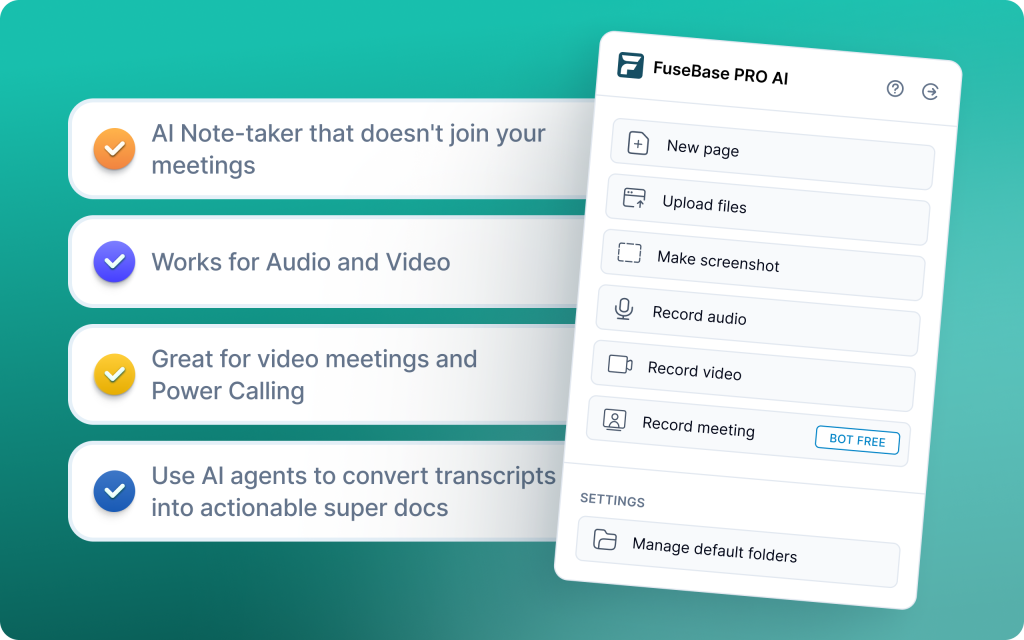
FuseBase is a bot-free AI meeting recorder and workspace that turns every Zoom, Teams, or Meet call into a branded mini-room with recap, files, and next steps. Instead of shipping a naked transcript link, you share a guided space that looks organized and premium. AI agents watch calls for risks, opportunities, and follow ups, then convert those signals into real tasks, trackers, and triggers across your workflows.
Standout features:
- Branded mini-rooms per meeting with recap, decisions, next steps, and key assets.
- White-label links on your domain for a premium client experience.
- Trackers that flag real revenue signals: no next meeting, missing budget, scope creep, renewal risk.
- Dashboards and AI agents that auto-create tasks and trigger follow ups across your tools.
- Consistent structure across discovery, QBRs, onboarding, and renewals to eliminate confusion
- Full work suite around each call: bot-free recording, personal notes, audio notes, async videos, and shared docs
Best-fit use cases:
- Discovery, QBR, onboarding, and renewal calls needing client-ready recaps + internal-only risks and coaching notes
- Auto-creating tasks, trackers, and follow ups from calls in your existing tools.
- White-label, branded sharing for a premium client experience across every meeting.
- CS and account reviews that monitor renewal risk and prevent missed handoffs.
2. Supernormal
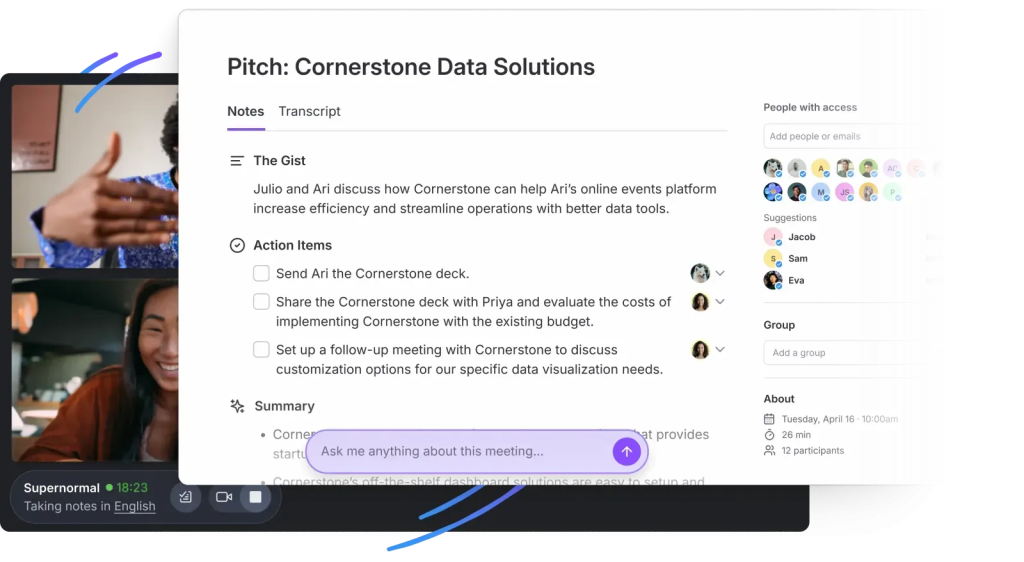
Supernormal is an AI meeting assistant that turns Zoom and Google Meet conversations into structured, on-brand documentation with real-time summaries and action items. It syncs notes and tasks into your existing tools so follow ups happen without extra admin. With customizable templates and 60 plus language support, every meeting produces consistent, shareable outputs that fit your workflow.
Standout features:
- Real-time agendas, recaps, and action items generated during the call
- Customizable summary templates per meeting type to match your process
- Action item detection and automatic assignment into your productivity stack
- Real-time AI assistant for live clarifications and highlights
- Topic and group-based note organization plus a personalized notetaker identity
Best-fit use cases:
- Sales and client calls that need structured, shareable summaries
- Project and implementation meetings that require template-driven documentation across teams
- Remote orgs that rely on deep integrations to keep notes and tasks in the tools they already use
3. Gong
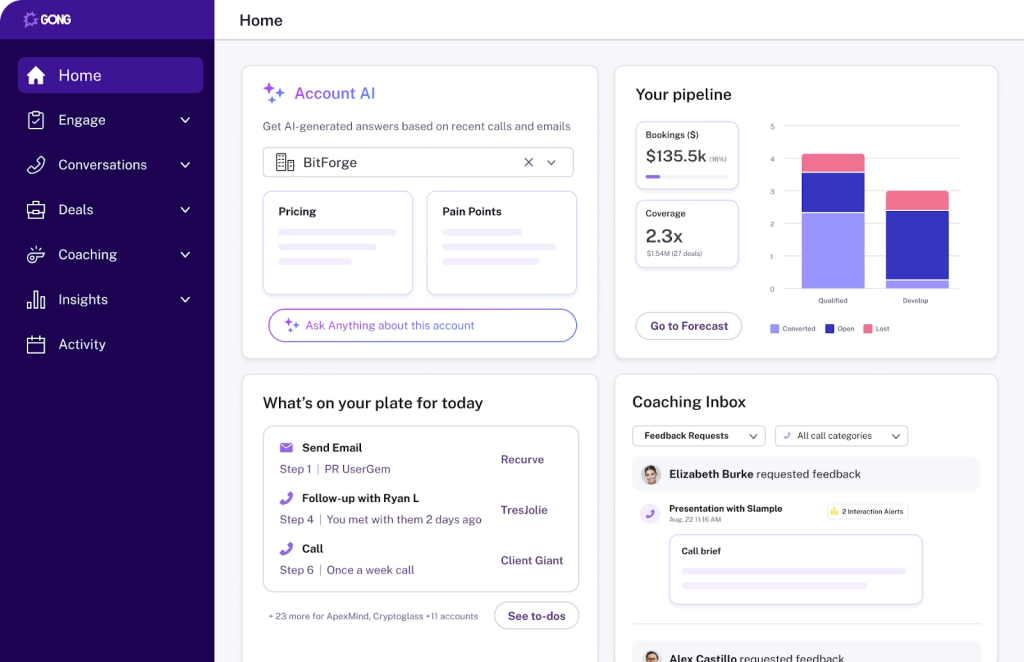
Gong is a revenue intelligence platform built for sales conversations that turns customer interactions into actionable insights. It analyzes calls, emails, and meetings to surface sentiment, product interest, deal risk, and next steps, then rolls those signals into pipeline views and AI-assisted forecasts. With deep CRM integrations and a robust metric library, leaders get clarity on what wins, where deals stall, and how to coach for higher win rates.
Standout features:
- Conversation intelligence: talk-time, sentiment, objections, and product-interest analysis
- Deal intelligence: risk flags on stalled next steps, missing stakeholders, and renewal threats
- Pipeline management: AI-assisted forecasts, stage health, and rollups tied to CRM
- AI summaries and suggested follow-ups after calls
- 70+ language support for global teams
Best-fit use cases:
- Enterprise sales orgs needing deep CI, deal health visibility, and forecast accuracy
- Revenue leaders who want coaching at scale with KPI-aligned dashboards
- Multilingual coverage and tight CRM integration to standardize reporting
4. Fathom
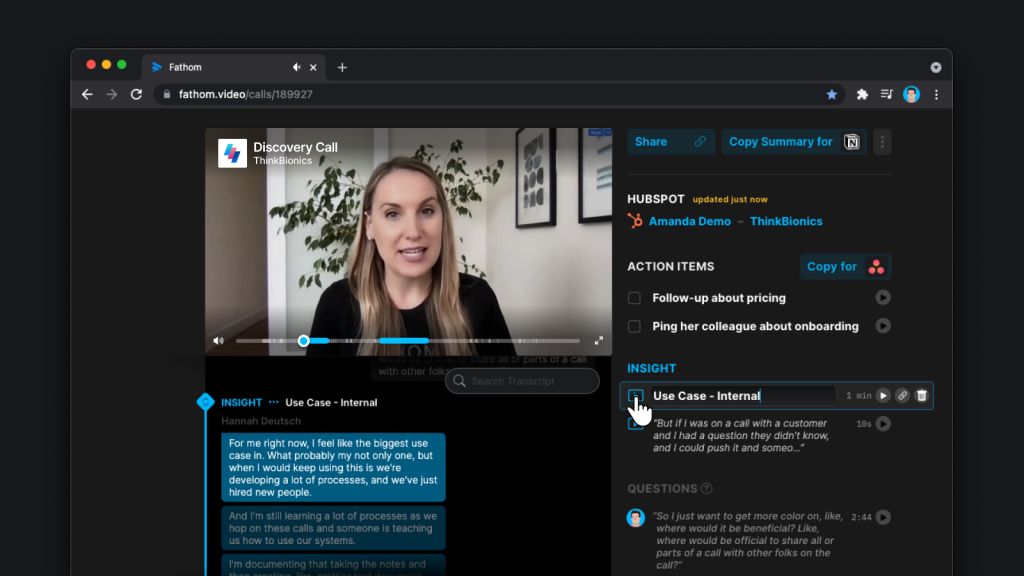
Fathom is a free-first AI notetaker that records, transcribes, and delivers instant summaries so reps can stay focused on the conversation. It pushes AI-generated insights, action items, and timestamps directly into CRMs like Salesforce, HubSpot, and Close to cut post-call admin. With templates, one-click highlights, and clip sharing, it’s built for fast follow ups and crisp handoffs.
Standout features
- Instant AI summaries with key points, to-dos, and timestamps
- Real-time talk-time tracking with monologue alerts for better call hygiene
- One-click highlights and shareable video clips for quick context
- CRM sync to Salesforce, HubSpot, and Close plus updates to docs and Slack/Notion
- Customizable templates for sales and CS meetings
- Works across Zoom, Google Meet, and Teams with support for 25+ languages
Best-fit use cases
- Reps who need fast, clean summaries and follow-up drafts right after calls
- Teams that want automatic CRM updates and minimal manual note logging
- Remote and global orgs sharing highlights to align stakeholders without rewatching full recordings
5. tl;dv
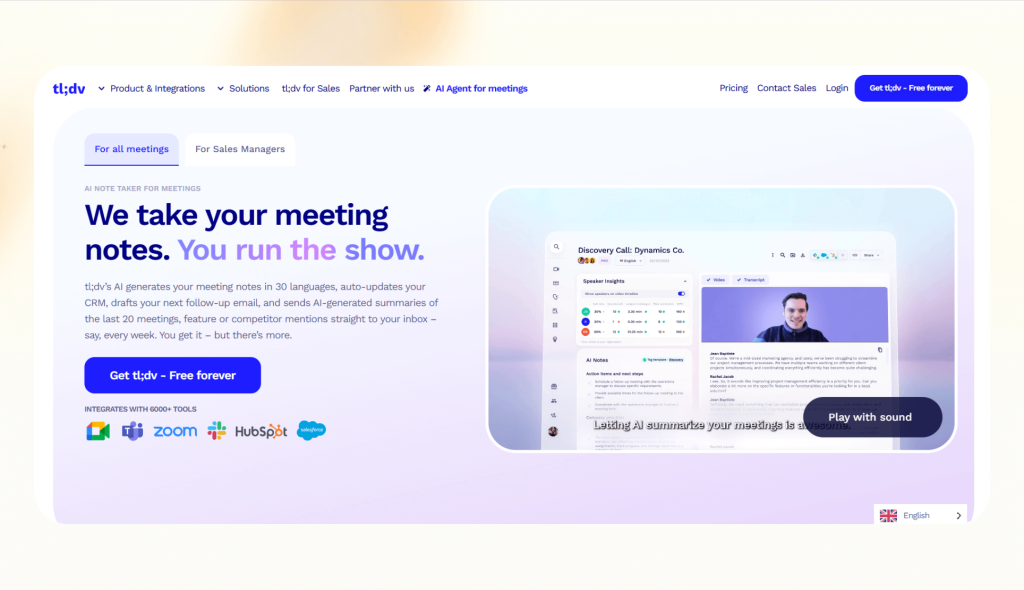
tl;dv is an async-first AI notetaker that records and transcribes Zoom, Teams, and Google Meet, then turns meetings into searchable, shareable assets. It can auto-update your CRM, draft follow-up emails, and provide coaching insights while staying lightweight and easy to deploy. Multi-meeting intelligence analyzes patterns across calls and emails you the takeaways so distributed teams stay aligned without rewatching full recordings.
Standout features:
- Multi-meeting intelligence that identifies trends and delivers reports to your inbox
- Built-in recording library with keyword search to surface moments instantly
- Highlight tagging, shareable clips, comments, and action item assignment for collaboration
- Auto-generated summaries, CRM updates, and follow-up drafts to speed execution
- Multilingual transcription with a tiny learning curve for quick rollout
Best-fit use cases:
- Remote and distributed Sales and CS teams that need async-friendly recaps and clips
- Global orgs that rely on multilingual transcription and simple CRM/doc integrations
- Teams prioritizing fast setup, searchable libraries, and lightweight coaching signals over heavy CI
6. MeetGeek
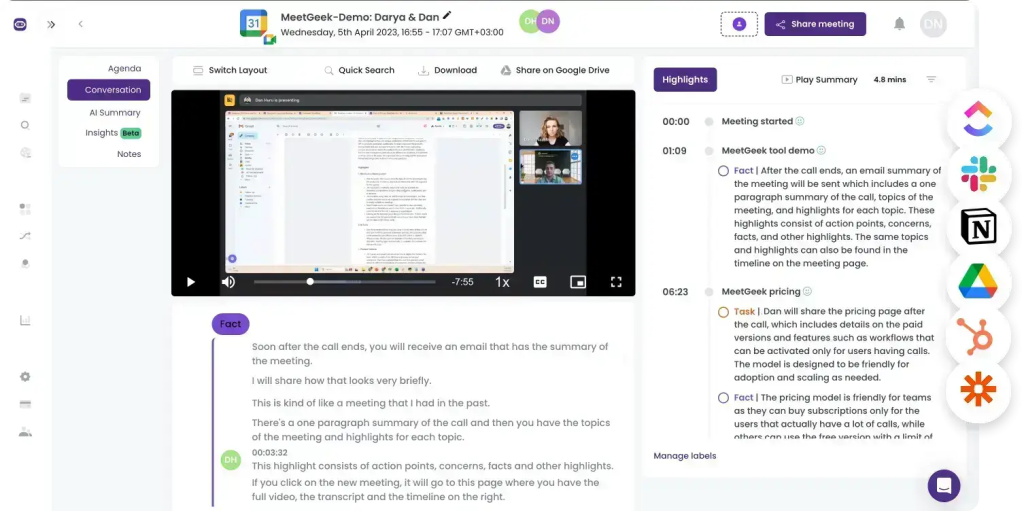
MeetGeek is an accuracy-first AI meeting assistant that automates transcription, summarization, and analytics so Sales and CS teams cut post-call busywork. It produces thorough summaries with action items, captures engagement and sentiment, and pipes outcomes into your stack through 7,000 plus integrations. With templates, a searchable library, and KPI-rich dashboards, it turns conversations into measurable improvements and reliable follow ups.
Standout features
- High-accuracy transcription in 20 plus languages, including from pre-recorded files
- AI summaries with action items, timestamps, and thorough context
- Engagement, sentiment, and 100 plus KPIs for coaching and performance tracking
- Auto-record and share with timestamps, plus organized, searchable meeting libraries
- Customizable meeting templates and folders to standardize discovery, QBRs, and onboarding
Best-fit use cases
- Sales and CS teams needing analytics-driven coaching, follow-up automation, and consistent call structure
- Orgs that want summaries and tasks to flow into existing tools with minimal manual cleanup
- Accurate multi-language capture and a shared library for cross-functional access
7. CustomerIQ
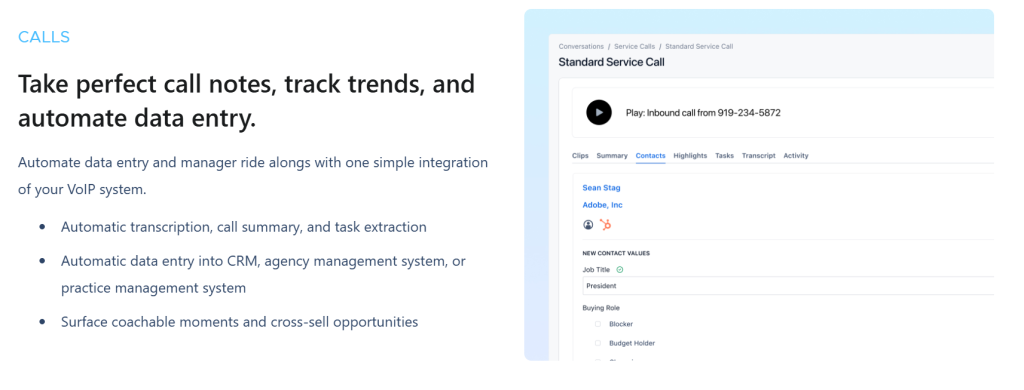
CustomerIQ is an AI revenue workspace that unifies meeting notes, email, and CRM updates so reps spend less time typing and more time selling. It auto-joins calls, captures AI notes, organizes inboxes, and drafts contextual replies and follow ups in your company voice. With cross-channel insights across calls and email, it flags risks, surfaces themes, and feeds clean data into Salesforce and HubSpot automatically.
Standout features
- AI meeting notes and voice notes that capture decisions, tasks, and next steps
- CRM automation that auto-populates contacts, companies, deal stages, and custom fields in Salesforce and HubSpot
- AI email assistant that organizes inboxes and drafts contextual replies and follow ups referencing specific discussion points
- Cross-channel theme analysis across calls and email to quantify customer needs
- Content, account, and workspace intelligence to centralize assets and strategy
Best-fit use cases
- Teams that want CRM data entry, follow ups, and inbox triage automated end to end
- Sales and CS orgs running both call-heavy and email-heavy motions that need one stream of truth
- RevOps and leadership that need cross-channel trends, risk alerts, and coaching signals to improve win rates and retention
Choosing the Best Avoma Alternative
Choosing an Avoma alternative comes down to one question: do you want a tool that simply summarizes meetings, or a platform that turns meetings into repeatable revenue outcomes. If your team lives in client calls, the best option is the one that reduces “after-call” work (follow-ups, handoffs, CRM updates, and next-step ownership) without adding friction for clients.
For most client-facing Sales and Customer Success teams, FuseBase is the best overall Avoma alternative because it goes beyond meeting notes. It’s built to convert call outcomes into structured execution: client-ready recaps, internal action plans, tasks, and deliverables that live in one workspace, with automation that helps keep momentum moving.
If you need a specialized path, the rest of the shortlist maps cleanly to different priorities. Gong is the right choice when you’re optimizing for coaching depth, deal inspection, and revenue intelligence across a larger team. MeetGeek is a practical, balanced option for teams that want consistent summaries, a strong meeting library, and solid value. tl;dv fits best when your workflow depends on sharing clips and highlights for alignment and enablement. Fathom is ideal for simple, low-friction notes for individuals or small teams. Supernormal works well when you want straightforward meeting summaries with minimal setup. CustomerIQ is best when your goal is voice-of-customer intelligence – spotting themes, product feedback, and requests across many calls rather than optimizing follow-ups for a single deal.